Table of Contents
Real advice from the trail, for anyone who wants more good days out there and fewer bad ones
Hiking doesn’t need to be dangerous to be taken seriously. Whether you’re logging your first mile of trail or your thousandth, these 22 field-tested safety tips cover weather, wildlife, water, navigation, and the small habits that keep a good hike from turning into a search-and-rescue story. Practical, no fear-mongering, just what actually works out there.
This is the single cheapest insurance policy in all of hiking, and it costs nothing but a text message. Tell a friend, partner, or family member which trailhead you’re starting from, which route you’re taking, and when you expect to be back. Then actually check in when you return. Search and rescue teams will tell you, again and again, that the hikers who get found fastest are the ones whose people knew where to start looking. A note on your dashboard works too, though a real person who’ll notice you’re late is better.
Trail difficulty ratings exist for a reason, and ego is the thing that gets people hurt on switchbacks. Look at mileage, elevation gain, and terrain honestly, and match it to your current fitness, not your best season three years ago. If you’re newer to hiking, start with well-trafficked, well-marked routes before you go chasing something remote. There’s no prize for overreaching on week one, and there’s a lot to be said for finishing a hike feeling strong instead of wrecked.
Mountain and desert weather can flip fast, and a forecast from twelve hours ago is already stale. Check again right before you leave the house, and again at the trailhead if you have signal. In many mountain ranges, afternoon thunderstorms build up like clockwork in summer, which is exactly why so many guides recommend starting early and being off exposed ridgelines by early afternoon. If the sky looks wrong or the forecast shifted, it’s fine to bail. The trail isn’t going anywhere.
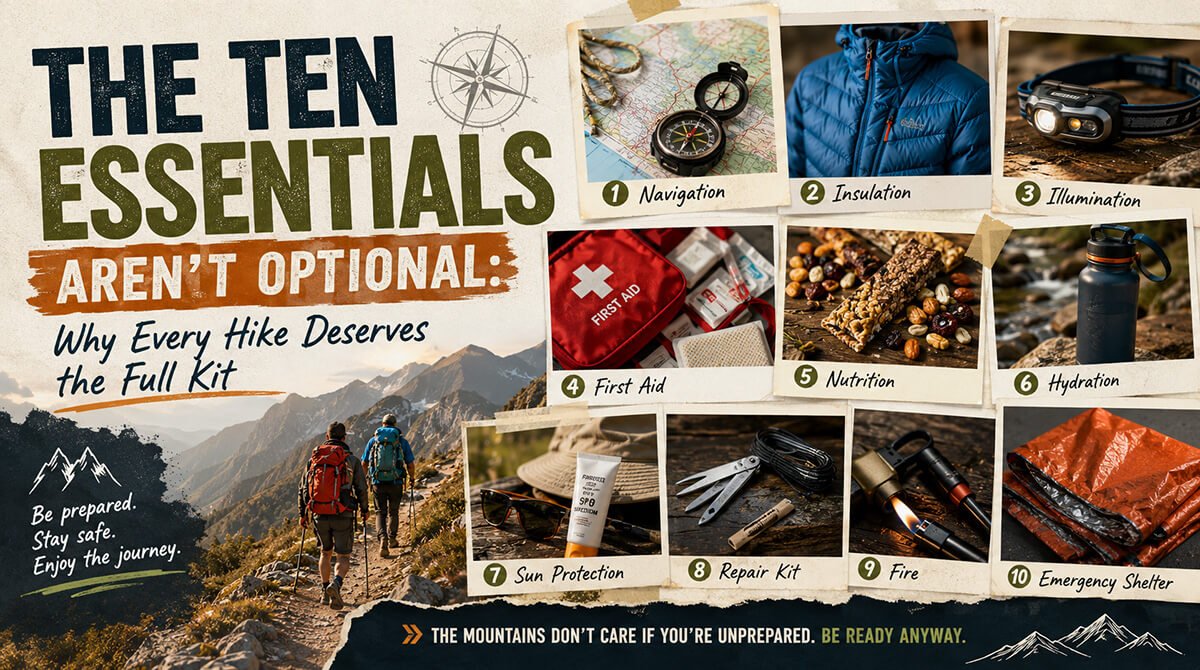
The Mountaineers formalized this list back in the 1930s, and it’s held up because it answers two simple questions: can you prevent an emergency, and can you handle one if it happens anyway? The modern version covers navigation tools, sun protection, extra layers, a headlamp, first aid supplies, a way to start a fire, a basic repair kit and knife, extra food, extra water or a way to treat more, and emergency shelter. You won’t use most of it on a normal Tuesday hike. The day you need it, nothing else in your pack will matter more.
A rough rule of thumb is around 16 to 20 ounces per hour of moderate hiking, more if it’s hot or you’re gaining serious elevation. Dehydration doesn’t announce itself politely, either. By the time you feel thirsty, you’re already behind. On anything longer than a short loop, bring a lightweight filter or purification tablets as backup rather than trusting that the stream on the map will still be flowing, or that your bottles will get you all the way back.
“Cotton kills” is an old backcountry saying for a reason. It soaks up sweat and rain, holds onto that moisture, and stops insulating right when you need it most. Wool or synthetic base layers wick moisture and dry fast, and a lightweight fleece or puffy stashed in your pack costs you almost nothing in weight or space. Layering isn’t about looking prepared. It’s about being able to adjust in five minutes flat when clouds roll in or the trail dips into shade at altitude.
Blisters have ended more hikes than bears ever will. Wear new boots around the neighborhood and on short walks before committing them to a big day, and pack moleskin or leukotape so you can treat a hot spot the moment you feel it, not an hour later when it’s already a blister. Merino wool socks help too. Your feet are doing all the work out there; treat them like it.
Phones die, screens crack, and GPS apps occasionally send people confidently in the wrong direction. A paper topo map and a basic compass don’t need batteries and don’t lose signal in a canyon. You don’t need to become an orienteering champion, just learn to orient a map to the terrain around you and shoot a rough bearing. It’s a skill you’ll use maybe once in fifty hikes, and it’s the difference between a wrong turn and a genuine emergency on that one.
That said, your phone is still a useful tool, and modern hiking apps have made backcountry navigation genuinely better than it used to be. Download the offline map for your route before you leave cell coverage, and carry a battery pack, because cold weather and constant GPS use drain phones fast. Treat your phone as a second system, not your only one.
Most wildlife encounters go bad because a person got closer than the animal was comfortable with, not because the animal was hunting for trouble. Keep your distance, never feed anything, and store food properly if you’re camping. In bear country, make noise on the trail so you’re not surprising anything around a blind corner, and know what to do if you do encounter one, since the right response varies by species. Respecting the distance isn’t about fear. It’s their home, and you’re the guest.
Heavy sweating, weakness, nausea, and a headache that won’t quit are your body telling you to stop, find shade, and drink water with electrolytes, not push for the summit. Heat exhaustion can slide into heatstroke, which is a genuine medical emergency, faster than people expect. On hot days, hike the exposed sections early, rest often, and take symptoms seriously the moment they show up rather than trying to tough it out to the car.
People associate hypothermia with snow, but it happens plenty in cool, wet, windy summer conditions, especially if someone’s wearing cotton and gets soaked by rain or sweat. Watch for shivering that won’t stop, clumsiness, slurred speech, and confusion in yourself and your hiking partners. If you see it, get the person dry, warm, and sheltered immediately. This is one where acting fast matters more than being certain.
Above roughly 8,000 feet, and especially above 8,200 or so, altitude sickness becomes a real possibility even for fit hikers. Headache, nausea, dizziness, and fatigue that feels out of proportion to the effort are the warning signs. The fix is almost always the same: stop ascending, rest, and descend if symptoms don’t improve. Trying to push through altitude sickness is how it turns into something more serious.
If you can hear thunder, you’re close enough to be at risk. Get off exposed ridges, summits, and open meadows, and avoid being the tallest thing around or standing under an isolated tree. This is exactly why an early start matters in mountain terrain that sees regular afternoon storms: plan to be off exposed sections before the buildup typically starts, and turn back without hesitation if you see it coming early.
Unmarked routes are where ankles turn, where people wander off route without noticing, and where fragile vegetation gets trampled for no good reason. Marked trails have usually been routed around the worst terrain and hazards for you already. If you want to explore off-trail, do it deliberately, with the navigation skills to back it up, not as an improvised detour because the real trail curved somewhere inconvenient.
Decide before you start hiking what time you’ll turn back, regardless of how close the summit or the waterfall feels. This single habit prevents more bad situations than almost anything else on this list, because the moment you’re standing at your turnaround time debating whether to push on, your judgment is already compromised by summit fever. Set the rule when you’re thinking clearly, and let the rule make the decision later.
There’s real safety in numbers, someone to help if you’re hurt, someone to go for help if you can’t move. If you’re hiking solo, and plenty of great hikes happen solo, stick to well-traveled trails, tell someone your plan without fail, and consider signing the trailhead register if one exists. Solo hiking isn’t reckless. Solo hiking without telling anyone where you went is.
It’s a two-dollar item that weighs nothing and carries about a hundred times farther than your voice will after an hour of yelling. Three blasts, three flashes of a light, three of anything, is the recognized distress signal. It’s one of those items on the essentials list that people skip because it seems unnecessary, right up until it isn’t.
A wilderness first aid class through the Red Cross or a similar organization will teach you to handle sprains, cuts, blisters gone wrong, and how to recognize when something needs a real evacuation versus some tape and ibuprofen. This is maybe the highest-value afternoon you can spend as a hiker. Knowledge weighs nothing and doesn’t run out of battery.
Cell coverage in the backcountry is better than it used to be, but plenty of canyons, valleys, and dense forest still swallow a signal completely. If you’re heading somewhere remote, a satellite messenger or personal locator beacon is worth the investment. They’re not just for expedition-level trips anymore; a lot of regular weekend hikers carry one now, the same way they carry a first aid kit, as a piece of gear they hope to never actually need.
Pack out everything you bring in, stay on trail, and leave what you find. This one might seem more about conservation than safety, but a trail that’s been trampled into a maze of braided social paths is a trail where people get disoriented and take genuine wrong turns. Taking care of the trail is part of taking care of the hikers who come after you, including future you.
This is the least measurable tip on the list and maybe the most important one. Experienced hikers and rescue professionals both describe the same pattern: the people who get into serious trouble are often the ones who noticed something felt wrong, a strange cloud, a twinge in a knee, a trail that didn’t match the map, and talked themselves out of acting on it. You don’t need a fully formed reason to turn around, slow down, or change plans. If your gut is talking, it’s worth listening to.
None of this is meant to make hiking sound like a minefield. It’s the opposite, honestly. The hikers I know who move through the backcountry with the most ease, the ones who seem to genuinely enjoy themselves out there instead of gritting through it, are the ones who’ve made this stuff automatic. They’re not thinking about the ten essentials on the trail, because the ten essentials are already zipped into the pack. They’re not worrying about the weather, because they checked it that morning and built in a turnaround time. That’s what good preparation buys you: not less adventure, but more room to actually be present in it.
Pick a trail this week. Check the forecast, tell someone where you’re going, and get out there.
Are you searching for ideas to plan your next trek? You’re in the perfect spot! 🙂 Hiking offers a unique way to uncover hidden gems and explore new areas at your own speed.
On this page, we share some of the most useful tips and tricks to help you get ready for your next adventure.



Recent Comments