
Table of Contents
Ask anyone who has climbed Mount Ararat what worried them most before the summit push and many will mention altitude sickness before they mention cold, steep terrain, or long hiking days.
For good reason.
Ararat rises to 5,137 meters (16,854 feet), high enough for the thin air to affect almost anyone, even people who are fit, experienced, and confident. I’ve seen strong hikers struggle at 4,000 meters while someone with less mountain experience walked steadily upward without a problem. Fitness helps. Acclimatization helps more.
If you’re planning an Ararat expedition through TurkTrek.com, or simply researching Mount Ararat altitude sickness, understanding how to prevent it can make the difference between standing on the summit and turning around hundreds of meters below it.
Why altitude sickness happens on Ararat
The higher you climb, the lower the air pressure becomes. At Ararat’s summit, your body gets significantly less oxygen with every breath than it does at sea level. Your brain, lungs, and muscles suddenly have to work with a reduced oxygen supply.
That’s when acute mountain sickness (AMS) can develop.
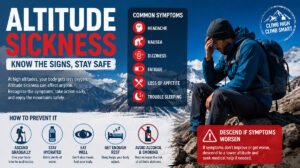
Common symptoms include:
On Ararat, symptoms often appear after reaching the high camp around 4,200 meters, or during the summit ascent that begins in the middle of the night.
A headache at altitude isn’t something to brush off. Think of it as your body’s check-engine light.
The biggest mistake beginners make
They climb too fast. Seriously. That’s the number one problem.
Many visitors arrive in eastern Turkey, feel strong during the approach hike, and assume the mountain will be straightforward. The first day usually feels manageable. The second day can be very different.
Your body needs time to increase breathing rate, adjust blood chemistry, and start producing adaptations that help deliver oxygen more efficiently. Those changes don’t happen in a few hours.
A sensible Ararat schedule
Recommended
Easy pace, lots of water
The acclimatization hike on Day 2 is not wasted time. It’s one of the main reasons many climbers succeed on summit day.
How to prevent altitude sickness on Mount Ararat
If you’re flying into Turkey from sea level, spend a day or two in the region before starting the climb. Places around Doğubayazıt are much lower than the summit but still give your body time to begin adjusting.
Dry mountain air pulls moisture from you with every breath.
A practical target is 3-4 liters of water per day during the climb. Urine should be pale yellow. Dark yellow means you’re behind.
Many climbers underestimate this because the weather on Ararat can feel cool, especially at night.
Altitude often suppresses appetite. Unfortunately, your body needs calories to cope with the extra work of breathing and climbing.
Simple foods usually work best:
Don’t wait until you’re starving.
This sounds almost too obvious, but it’s where experienced mountain guides earn their keep.
A good Ararat pace is one where you can hold a conversation without gasping between sentences. If you’re breathing hard continuously, slow down. The mountain isn’t going anywhere.
Alcohol contributes to dehydration and can make it harder to recognize developing symptoms. Most guides, including the team at TurkTrek.com, recommend avoiding it entirely during the climb.
Diamox (acetazolamide) is commonly used for altitude sickness prevention. It helps your body acclimatize more quickly by encouraging deeper breathing.
Some climbers take it preventively, while others carry it as a backup. The decision should be made with your doctor, especially if you have medical conditions, take other medications, or have never used Diamox before.
Common side effects include tingling fingers, increased urination, and altered taste for carbonated drinks. Oddly specific, but many people notice it.
When a headache becomes a warning sign
Not every headache means you have AMS. Dehydration, fatigue, and lack of sleep can all cause headaches.
Pay attention to patterns.
A concerning combination looks like this:
Warning signs that should not be ignored
If those symptoms appear, descending is the safest treatment. No summit is worth gambling with serious altitude illness.
Imagine you’re at High Camp around 4,200 meters.
You have a mild headache, but you’re drinking water, eating dinner, and chatting normally. You sleep reasonably well. In the morning the headache is gone. That’s often manageable.
Now imagine the headache gets worse overnight, you can’t finish breakfast, and you feel dizzy when standing up. That’s a different picture entirely. A responsible guide will reassess whether continuing upward makes sense.
Good mountain decisions are usually made before things become dramatic.
Why prevention matters so much
Altitude sickness doesn’t care how expensive your gear is. It doesn’t care how many marathons you’ve run. It doesn’t care how motivated you are.
What it does care about is how quickly you ascended, how well you hydrated, how much you rested, and whether you listened to early warning signs.
On Mount Ararat, the summit day is demanding. You’re starting in darkness, climbing on loose volcanic terrain, often dealing with cold wind, and gaining nearly 1,000 vertical meters. If altitude sickness is already developing, that effort becomes exponentially harder.
Prevention isn’t just about safety. It’s about enjoyment. The climbers who acclimatize well usually remember the sunrise over eastern Turkey, the view toward Iran and Armenia, and the surreal feeling of standing above a sea of clouds. The climbers who ignore the basics often remember a pounding headache and a miserable descent.
If you’re searching for how to prevent altitude sickness on Ararat, focus on the fundamentals:
Simple habits. Huge payoff.
Every season, TurkTrek.com guides climbers with very different backgrounds, from first-time trekkers to experienced mountaineers, up Mount Ararat. The people who have the smoothest summit day are rarely the fastest hikers. They’re usually the ones who respected the altitude from the beginning.
And on a 5,137-meter volcano, respect goes a long way.

Recent Comments